
Build a Production RAG Chatbot in 2026
Ship a reliable RAG chatbot in 2 to 4 months. Learn the exact pipeline, benchmarks, and retrieval tuning steps for production grade accuracy.
Build a Production RAG Chatbot in 2026
A RAG chatbot pairs a large language model with a private document store, grounding every answer in retrieved facts instead of training data guesses. The gap between a demo and a production system comes down to data quality, retrieval tuning, evaluation harnesses, and operational guardrails.
Teams that skip systematic evaluation ship systems that degrade silently as document corpora grow.
RAG Chatbot Architecture and Core Components
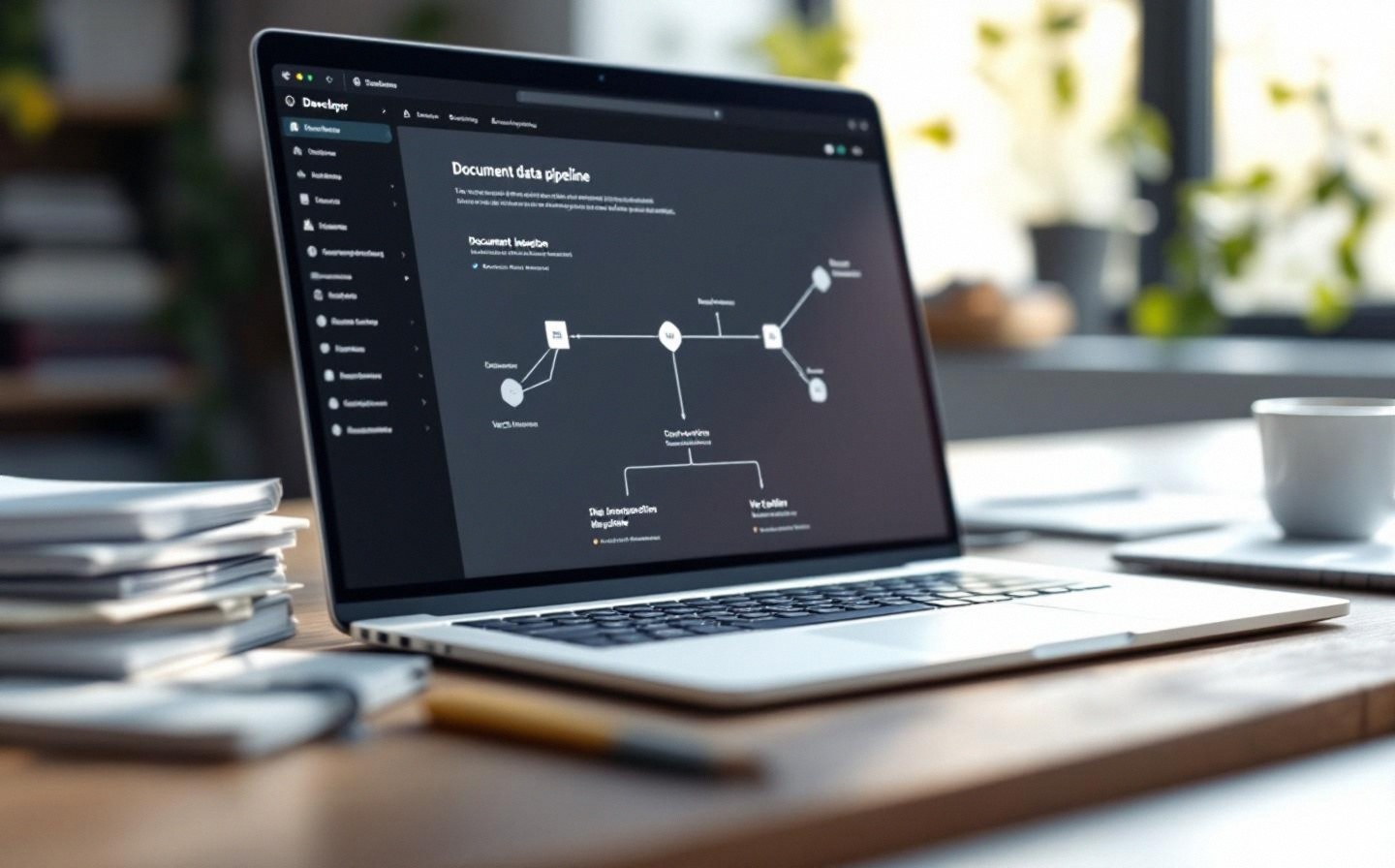
The pipeline ingests documents, chunks the text, generates embeddings, retrieves candidates, reranks results, and routes the query to an LLM API. Each stage must be independently measurable and replaceable.
Feed markdown, PDFs, and wikis into a single pipeline. Chunk everything into 250 to 500 token passages with 10 to 15 percent overlap. Heading-aware splitting preserves structure, and code blocks and tables need special parsing to prevent fragmentation. Store vectors in a managed database or pgvector, and generate them using a reliable embedding API.
Advanced Chunking Strategies
Chunking is frequently underestimated. Arbitrary sizes destroy semantic coherence. Use recursive character splitting that respects natural boundaries like paragraphs, and attach parent headings, document version, and author as metadata for precise filtering and better citation accuracy.
When handling code-heavy docs, preserve indentation and validate chunk boundaries against your top 50 user queries. If queries return partial context, increase overlap or switch to hierarchical chunking. API references benefit from endpoint-level chunks grouping parameters and schemas; legal contracts should chunk by clause; internal wikis often need larger 500 to 800 token chunks.
Always test your strategy against real user questions before production. Track chunk size distribution to avoid confusing the reranker with tiny fragments.
Retrieval Tuning and Reranking Benchmarks
A reranking layer lifts nDCG@10 by 5 to 15 points on tough queries. Pull a broad candidate pool first, then reorder results to maximize top-k relevance. Hybrid search combining BM25 and vector similarity catches technical terms, exact API names, version numbers, and error codes that pure vector search often drops.
Measure retrieval quality with Precision@K, Recall@K, and nDCG before testing generation. The BEIR benchmark suite tracks these metrics across 18 datasets. Run these metrics weekly against a rolling window of user queries to catch retrieval drift.
A reranker adds under 200 milliseconds of latency while cutting irrelevant citations. RAGBench evaluates relevance and utilization RMSE across five industry domains. Track candidate pool size carefully: 50 to 100 candidates gives the reranker enough signal, and going beyond 200 yields diminishing returns while increasing compute costs.
Handling Edge Cases in Retrieval
Standard vector search struggles with polysemy, version conflicts, and multi-hop queries. A term like client might refer to a browser, a server process, or a customer account depending on context. Use query rewriting to disambiguate terms before embedding, and add explicit version filters to your metadata schema so the retriever never mixes v2 and v3 API documentation.
Multi-hop queries require chaining retrievals. Retrieve the first answer, extract the next entity, and run a second retrieval pass. This two-step approach improves accuracy for complex troubleshooting scenarios; implement a maximum hop limit to prevent infinite loops and track hop depth in your telemetry.
Hallucination Reduction and Accuracy Metrics
RAG chatbots cut hallucinations by grounding responses in retrieved documents instead of relying on model weights. MEGA-RAG reports 0.7913 accuracy and over 40 percent hallucination reduction versus standard RAG on public health QA tasks using multi-source evidence retrieval.
Track answer faithfulness, context precision, and citation accuracy using dedicated evaluation datasets. RAGTruth contains 18,000 naturally generated responses for hallucination analysis, and FRAMES measures factuality and retrieval accuracy across diverse tasks. Build a regression test suite with 200 to 500 representative queries and run it after every chunking change, embedding update, or prompt revision.
Enforce strict prompts that constrain responses to retrieved chunks and require source links. Add guardrails that refuse answers when retrieval confidence drops below your threshold. A refusal rate of 5 to 10 percent is normal and improves trust.
Building an Evaluation Harness
Automated evaluation requires a structured grading pipeline. Use LLM judges or dedicated scoring models, such as Prometheus, which detects hallucinations faster than manual review. Alert your team when faithfulness scores drop below 0.85 or citation accuracy falls below 0.90.
Combine automated metrics with human review for high-stakes queries. Create a triage system where low-confidence answers are flagged for human annotation, then feed corrections back into your gold standard test set. Track false positive and false negative rates separately to understand whether your system is over-answering or under-answering.
Log every evaluation run with timestamps and configuration hashes to reproduce results later.
Production Timeline and Implementation Steps
A small team ships a working prototype in three weeks and reaches production readiness in ten. The timeline below assumes a focused scope and a single document source to start.
Week one: audit data, define success metrics, and ingest a single document source. Pick 20 to 50 representative queries to establish baselines, mapping each to the exact document section that contains the answer. Set up version control for your chunking configuration and prompt templates.
Weeks two and three deliver a working prototype with basic vector search, citation formatting, and an OpenAI-compatible chat API. Weeks four through six tune chunking parameters, add metadata filters, and integrate a reranker. Add hybrid search at this stage to catch exact term matches, and log every failed retrieval to identify systematic gaps.
Weeks six through ten harden the system with authentication, logging, and guardrails for prompt injection. Add rate limiting, query sanitization, and output filtering. Implement structured logging that captures query text, retrieved chunk IDs, reranker scores, and final token counts.
Months two through four cover full production rollout, automated freshness checks, and user deployment. Build dashboards for retrieval latency, token usage, and answer quality. Set up CI/CD pipelines that run evaluation suites before deploying new chunking or prompt configurations.
Managing Inference Costs and Data Residency
Deploy on dedicated GPUs in your required region to meet data residency and compliance requirements. Flat monthly pricing for managed inference keeps costs predictable at scale.
Use smaller models for simple factual lookups and reserve larger models for complex reasoning tasks. Route queries dynamically based on complexity scores to optimize spend. Cache frequent queries with a short TTL and return cached answers with a freshness disclaimer when the primary pipeline is slow.
Optimizing Token Usage and Caching
Token consumption scales with context window size and retrieval depth. Implement aggressive prompt compression to strip low-scoring chunks before they reach the model. Use quantized embedding models to reduce memory footprint without sacrificing retrieval quality.
Layer your caching strategy to handle different query patterns. Cache exact matches at the application layer for sub-millisecond responses; cache reranked context at the vector store layer for moderate traffic. Implement a cache invalidation policy tied to document version updates to prevent stale answers from persisting.
Monitor cache hit rates and adjust TTLs based on your document update frequency. See our cost calculator to estimate token usage.
Common Failure Modes and Mitigations
Even well-designed RAG systems encounter predictable failure patterns. Recognizing these early saves weeks of debugging.
Bad retrieval is the most common root cause. The model gets blamed for wrong answers, but the retriever simply failed to surface the correct document. Fix this by expanding your candidate pool, adding hybrid search, and improving metadata tagging. Never optimize prompts before fixing retrieval.
Stale content breaks trust quickly. Users expect current information, but indexes often lag behind source updates. Schedule incremental indexing jobs triggered by webhooks or cron schedules, and display last-updated timestamps prominently in citations so users can verify freshness.
Overconfident refusals frustrate users. If your confidence threshold is too strict, the bot will say it does not know the answer when it actually has the information. Calibrate refusal thresholds using your evaluation harness, aiming for a refusal rate that matches your acceptable error tolerance, typically 5 to 10 percent.
Hidden operational costs accumulate from logging, reindexing, and evaluation runs. Track token usage per query, embedding refresh frequency, and vector store growth. Implement tiered storage for older documents and archive inactive knowledge bases to control database size.
Security, Access Control, and Operational Reliability
A production RAG chatbot must enforce document-level permissions and handle sensitive data safely. Implement role-based access control that filters retrieved chunks before they reach the model. Map user groups to document tags during ingestion so the vector store enforces permissions natively.
Redact personally identifiable information before generating embeddings. Run a PII detection pass during ingestion to strip names, addresses, and internal identifiers. Store access logs separately from content logs to maintain audit trails without exposing raw data.
Encrypt vectors at rest and in transit, and implement network isolation for your vector store and embedding services. See OWASP’s LLM Top 10 for a current list of security risks specific to LLM-backed systems.
Document freshness is a constant operational challenge. Policies change, API specs get deprecated, and runbooks get updated. Schedule daily incremental indexing jobs and trigger reindexing on source system webhooks, and display last-updated timestamps in citations so users know when to verify critical information.
Build fallback mechanisms for high latency or degraded service. Implement circuit breakers that switch to a simpler retrieval mode if the reranker or embedding service times out. Set up automated alerts for sudden drops in retrieval precision or spikes in refusal rates.
FAQ
How long does it take to build a RAG chatbot?
Teams usually ship a prototype in two to four weeks and a production-grade system in two to four months. Adding authentication, automated freshness, and evaluation harnesses will stretch that timeline. Start with a narrow scope and expand iteratively.
Does RAG actually reduce hallucinations?
Yes. Benchmarks show retrieval grounding cuts citation hallucination by 75 to 90 percent and improves accuracy by over 40 percent in domain-specific tasks. Strict prompts and refusal behavior keep unsupported claims in check. Grounding works best when retrieval quality stays high.
What is the best RAG architecture for internal docs?
Stick to 250 to 500 token chunks, hybrid retrieval, a cross-encoder reranker, and an OpenAI-compatible API. Enforce citations and metadata filters to keep precision and data security high. Use managed embeddings and a simple vector store to reduce operational overhead.
How do you evaluate RAG chatbot performance?
Track retrieval Precision@K and Recall@K, answer faithfulness, and citation accuracy. Run regression tests against a gold standard query set after every document update. Monitor production logs for retrieval failures and user dissatisfaction signals, then iterate on chunking and reranking parameters until metrics stabilize.